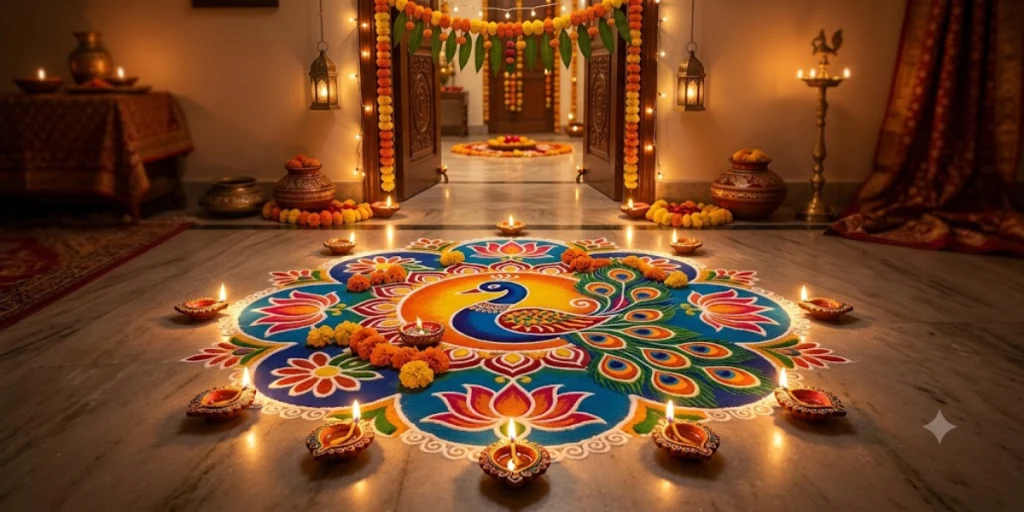
Diwali is a festival of lights, happiness, and decoration. People clean their homes, light diyas, and decorate their entrances to welcome prosperity and positivity. A beautiful rangoli design for Diwali is one of the most popular ways to make a home look festive and welcoming.
There are many types of rangoli designs to choose from, including simple floral patterns, traditional designs, diya shapes, and colourful peacock motifs. You can select a design based on your available space, time, and artistic skills. Here are some beautiful ideas to help you decorate your home this Diwali.
Simple Rangoli Design for Diwali
Simple rangoli designs are perfect for people who want to decorate their homes without spending too much time. You can create a circular pattern, a flower shape, or a design with four petals using only a few colours.
Red, yellow, white, and green are popular choices for festive patterns. You can also add a small diya in the centre to make the design look more attractive. These designs work well near the main entrance, in front of the door, or beside a पूजा area.
Easy Rangoli Designs for Beginners
If you are new to making rangoli, start with easy patterns that do not require detailed drawing. Dot-based rangoli, small flowers, and simple geometric shapes are good options.
First, draw an outline using chalk or white rangoli powder. Fill the spaces with your chosen colours and use your fingers or a small spoon to spread the powder carefully. Beginners can also use stencils to create neat and balanced patterns.
Traditional Diwali Rangoli Designs
Traditional rangoli designs are a popular choice for Diwali celebrations. Common patterns include lotus flowers, symmetrical circles, decorative borders, and auspicious symbols.
You can use bright colours such as red, yellow, orange, and green to create a festive appearance. White outlines help separate the different patterns and make the design clearer. Traditional rangoli looks especially attractive near the main entrance or in a clean area used for पूजा and festive decorations.
Flower Rangoli Design for Diwali
A flower rangoli design for Diwali is a natural and colourful way to decorate your home. Fresh marigold petals, rose petals, and other colourful flowers can be arranged in circular, floral, or layered patterns.
Start by making a simple outline on the floor. Place flower petals along the outline and fill the remaining spaces with different colours of petals. You can add green leaves around the edges for a fresh look.
Flower rangoli is a good option for people who prefer natural decorations instead of coloured powder. It can also be combined with small decorative diyas placed safely around the design.
Diya Rangoli Design for Diwali
Diya rangoli designs represent the festive spirit of Diwali. You can draw a large diya shape in the centre and decorate it with colourful patterns, small flowers, and decorative borders.
Use yellow and orange for the flame, red for the diya, and white to create fine outlines. Another idea is to make a circular rangoli with a diya-inspired pattern in the middle.
If you want a simple design, draw a small diya and surround it with flower petals or dots. Keep real diyas on a stable, non-flammable surface and away from rangoli powder, flower petals, and other combustible decorations.
Peacock Rangoli Design
Peacock rangoli designs are suitable for people who enjoy colourful and detailed artwork. The peacock’s feathers allow you to combine several shades, including blue, green, yellow, and purple.
For an easy version, draw the outline of a peacock and fill its body and feathers with bright colours. Beginners can create a smaller feather pattern instead of drawing the entire bird.
You can use white powder to add small details around the feathers. A peacock design looks attractive in a spacious entrance or courtyard where the full pattern can be seen clearly.
Corner Rangoli Designs for Home
Corner rangoli designs are useful when you have limited floor space. These patterns can be placed beside the main door, near a wall, or in an available corner of the living room.
Try a semicircle, a small lotus, or a quarter-flower pattern. You can also create a decorative border that follows the shape of the doorway.
Choose two or three colours for a clean appearance. Small corner designs are easy to maintain and allow you to decorate your home without covering a large area.
Small Rangoli Designs for Diwali
Small rangoli designs are ideal for apartments, narrow entrances, and homes where there is limited space. A small circular flower, a star-shaped pattern, or a few colourful petals can create a festive look.
You can make a quick design using white outlines and two contrasting colours. Adding a small diya motif in the centre can make the pattern more suitable for Diwali.
These designs are also helpful when you want to create rangoli in several areas of your home without repeating the same pattern everywhere.
Rangoli Designs with Colours and Flowers
Combining rangoli powder with flower petals creates a decorative and festive effect. You can use coloured powder for the main pattern and fresh petals to decorate its borders.
For example, create a circular design with red and yellow powder, then add a border of orange marigold petals. White outlines can help the colours stand out.
Choose colours that complement one another rather than using too many shades in a small design. This approach makes the rangoli look balanced and easier to complete.
How to Make Rangoli for Diwali at Home
Follow these simple steps to create your own rangoli:
- Clean the area: Sweep the floor and make sure the surface is dry.
- Choose a design: Select a pattern that matches your available space and skill level.
- Draw the outline: Use chalk or white rangoli powder to mark the basic shape.
- Add colours: Fill the design carefully, starting with the larger sections.
- Create details: Add dots, petals, borders, or small decorative patterns.
- Finish the design: Remove extra powder around the edges and check that the pattern looks balanced.
You do not need expensive materials to create an attractive rangoli. Basic colours, flowers, and a little patience are often enough.
Tips for Making a Beautiful Diwali Rangoli
Keep these tips in mind when creating your rangoli:
- Select a design that matches the size of your entrance or floor space.
- Use contrasting colours to make the pattern more visible.
- Start with simple shapes before trying detailed artwork.
- Use a stencil if you want clean and consistent outlines.
- Combine flower petals and coloured powder for variety.
- Avoid placing rangoli where people frequently walk, as the powder may spread.
- Keep diyas and other open flames away from loose powder, petals, fabrics, and other flammable decorations.
A well-planned design can look beautiful without requiring complicated patterns or too many colours.
Frequently Asked Questions
1. Which rangoli design is best for Diwali?
Simple floral, lotus, circular, and diya-inspired designs are popular choices. The best option depends on your available space, personal preference, and experience.
2. How can beginners make a simple Diwali rangoli?
Beginners can start with a circular or flower-shaped pattern. Draw the outline with chalk, fill it with two or three colours, and add a simple border.
3. Which colours are best for Diwali rangoli?
Red, yellow, orange, green, blue, and white are popular choices. You can combine contrasting colours to make the design stand out.
4. Can I make rangoli with flower petals?
Yes. Marigold and rose petals are commonly used to create natural rangoli patterns. You can arrange them in circles, flowers, or decorative borders.
5. Where should I make rangoli at home during Diwali?
You can make rangoli near the main entrance, in a courtyard, or in another clean and suitable area. Choose a place where the design will not obstruct walking or create a fire hazard.